

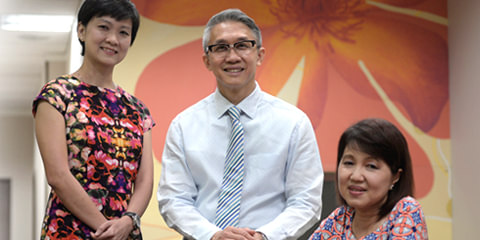
Our dermatologists at the Specialist Skin Clinic have more than 60 years of combined experience and specialise in the diagnosis and treatment of vitiligo.
Dr Cheong Wai Kwong, past President of the Dermatological Society of Singapore (2000 – 2005), is experienced with the use of various lasers and IPL for treating acne, acne scars, pigment problems such as freckles and age spots and removal of tattoos and birthmarks as well as Exilis® for non-invasive face lift. He has expertise in the use of ultraviolet radiation (phototherapy) for treating skin conditions such as psoriasis, eczema and vitiligo.
Dr. Phay Ken-Lin is also an accredited Fellow of the Academy of Medicine, Chapter of Dermatologists. Her practice encompasses all aspects of general dermatology pertaining to children and adults. She is highly regarded in the field of cosmetic dermatology and has special interest in the treatment of acne and acne scars and pigment disorders.
Dr Neoh Ching Yin evaluates and treats all general medical and surgical conditions of the skin, mucous membrane, hair and nails in both adults and children. Her special interests include management of atopic eczema and medical dermatology that covers conditions such as psoriasis, lupus erythematosus, blistering skin diseases like pemphigus and pemphigoid and recurrent oral ulcers. In recent years, she has also developed a keen interest in the treatment and evaluation of hair loss.
If you are stepping in for a vitiligo consultation, you should expect a good and thorough discussion to know more about your vitiligo and the available treatment options. To help you prepare for your appointment, you may review your family medical history to take note if you know someone in your family who has vitiligo.
Your dermatologist will first assess your condition using a special examination light called the Wood’s light. He/she will then explain the various treatment options that are most appropriate for you. Do not hesitate to ask your doctor anything related to your condition as quality care begins with good communication. A good dermatologist will take time to listen and to explain the types of treatment options available.
Vitiligo is a melanocyte (pigment cell) disorder, which results in areas of the skin or hair losing their pigmentation It can affect people of any race, age or gender.
Global incidences vary between 0.5 to 2 percent. However, the impact is often more visible among ethnic groups with darker skin, due to the sharper contrast between the depigmented areas and normal skin.
The precise cause of vitiligo is unknown, although it is thought to be an autoimmune disorder. This means that the patient’s immune system attacks the melanocytes ( pigment cell) in the skin. It is not clear however, what causes the immune system to react that way. Genetics are thought to play a role as between 6 to 38 percent of patients have a family history of the disorder.
There are no proven measures to prevent vitiligo. However we know that vitiligo can appear in areas of the body that have been injured by cuts, abrasions or burns. As such, those who have vitiligo should try to avoid any kind of repeated trauma to themselves especially the extensor area of their limbs.
Creams
Topical steroid creams are effective in up to 50 percent of patients. Results are usually seen in the first three months of treatment. However, as these creams can cause side effects such as thinning of the skin, patients should be regularly monitored by a skin doctor.
Immunomodulator creams such as tacrolimus and pimecrolimus work by reversing the immune attack on the pigment cell. As they do not contain steroids, they can be used for longer periods.
Our fees for first consultation starts from $90 - $180.
We value your time and that is why we strongly advise that you make a prior appointment with our staff so our dermatologist can also meet you on an allocated time. Please call or email us for an appointment.
or Send Us Your Enquiry
1 Grange Road #06-04
Orchard Building
Singapore 239693
Tel: +65 6734 1411
Fax: +65 6235 5900
Email: enquiry@specialistskin.com.sg
Mon - Fri: 8:30am - 5:00pm
Sat: 8:00am - 1:00pm
Closed on Sundays and public holidays
We are conveniently located at 1 Grange Road #06-04 Orchard Building Singapore 239693. Location is assessable via Somerset Road, making a right turn into Grange Road.
If you require further directions to our office, please call us at +65 6734 1411.
